Frontline Delivery : Ukraine’s Amazon for the Trenches
Brave1 Market delivers frontline needs ordered online directly to military units. A robot-run system: faster, more efficient, less vulnerable. A serious food for thought for European armies.
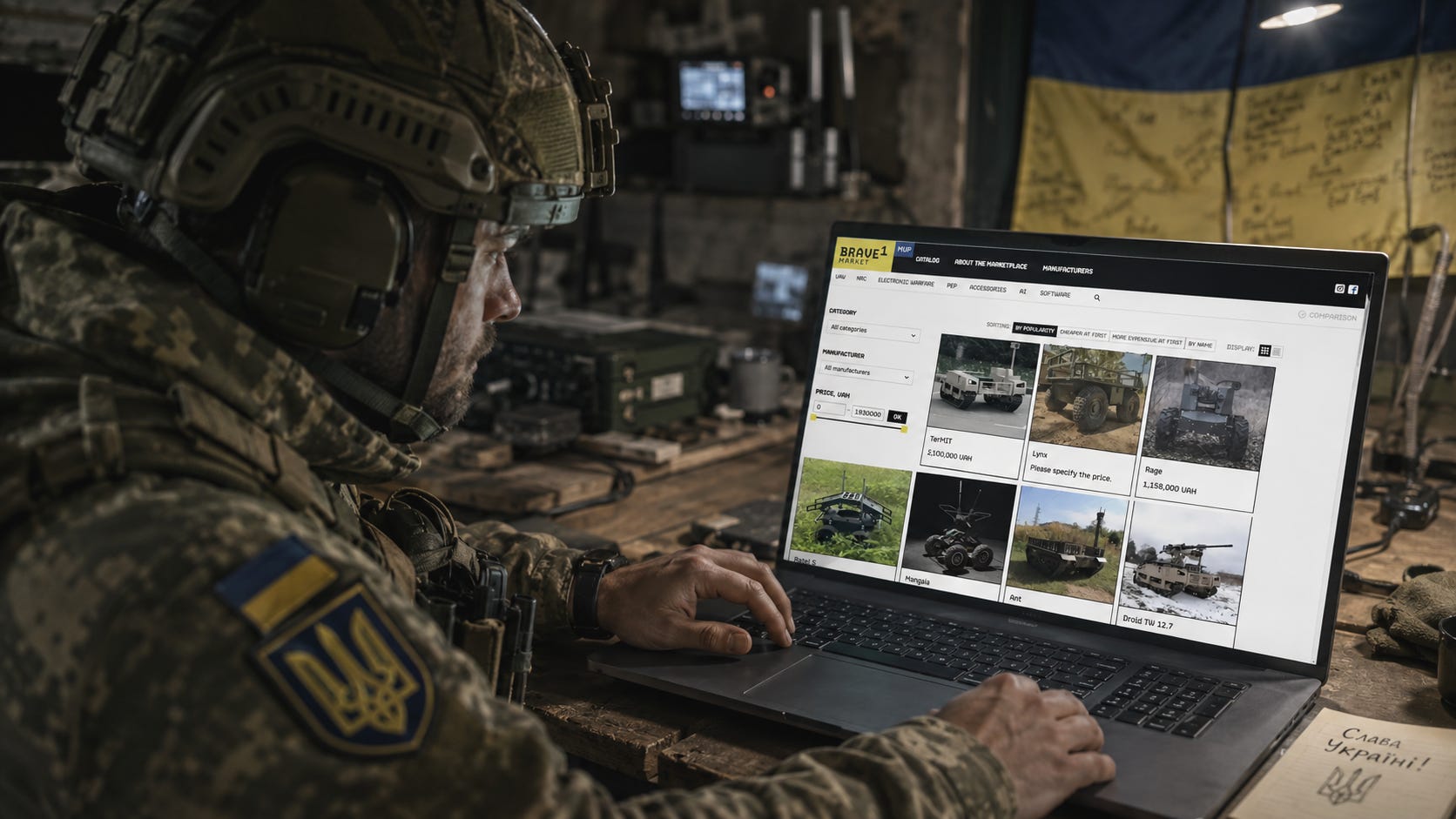
A Ukrainian soldier browsing the Brave1 Market website (image created with AI)
In Short
• The Ukrainian Ministry of Defense has mandated that 100% of ground logistics be handled by robots. The goal is to eliminate the vulnerability of traditional supply convoys.
• At the center of this shift is Brave1 Market. Its effectiveness scales alongside the dramatic surge in the quantity and durability of Ground Robotic Systems (GRS).
• To sharpen the system, Ukraine has implemented systematic gamification: the more “kills” a unit confirms, the more purchasing power it earns on the platform.
The Full Story
The Ukrainian army is operating under a brutal reality: how to sustain a high-intensity, protracted war with dwindling human resources. Consequently, defense-tech firms have been handed a clear directive: “automate combat” to the furthest extent possible and reduce troops exposure as much as possible.
In late April, Kyiv urged its partners to accelerate the production of aerial and maritime drones, but placed a particular emphasis on ground robots. These machines have become the cornerstone of the most sophisticated field-logistics apparatus ever deployed in a theater of operations.
The objectives set by the Minister of Defense, Mykhailo Fedorov—appointed just three months ago—are ambitious. In the short term, he has ordered that 100% of field logistics be robotic. During the first half of 2026, the government plans to acquire 25,000 Ground Robotic Systems (GRS), doubling its 2025 procurement. These robots currently execute roughly 10,000 missions per month—twice the volume seen just six months ago.
Minister of Defense, Mykhailo Fedorov
Boris Drozhak, an executive at Rovertech—a firm that has captured a significant share of the market—describes a frictionless system. Robots deliver supplies at ranges of up to 150km and return carrying the wounded. Rovertech’s latest models can haul a ton of material. They also have been considerably hardened. “Previously, their lifespan didn’t exceed seven missions; today, we see up to 80,” says Drozhak. “We’ve seen them return riddled with impacts of RPGs, IED, enemy drones, having spent hours transporting a wounded soldier who survived as a result.” Control systems have also been upgraded and diversified; operators now navigate via four redundant networks—Starlink, GSM, and two proprietary radio systems—depending on the terrain and electronic warfare environment.
The “nervous system” of this logistical feat is a platform inspired by Amazon or Alibaba but augmented by a chillingly dystopian layer. Launched early last year, Brave1 Market now operates as a full-scale e-commerce engine. It features a catalog of 3,000 items from 600 vetted suppliers. Across 11 categories, buyers find everything from multi-configuration drones and infrared-cloaking suits, to spare parts, ammunition, and medical supplies. Access is strictly tiered by personnel clearance.
Suppliers must go through a Ministry of Defense vetting for product relevance, quality, and financial solvency. Once an order is placed, delivery takes 6 to 9 days. As with any consumer site, the “customer” rates the service and the product. If a piece of kit proves exceptionally effective—and thus high-demand—the Ministry fast-tracks its production, bypassing traditional procurement bottlenecks. Bureaucracy can’t obstruct the fighter’s needs: if the users say it’s good, it must be available.
The transactional system is perhaps the most striking feature. Unit commanders pay for equipment using points earned through combat performance. The “Army of Drones Bonus Program” is constantly refined, but its most controversial element is the systematic gamification of “kills.” Every video documenting a strike on enemy troops or hardware is submitted to the Ministry for validation. Initially, a “kill” required a witness drone (typically a commercial DJI Mavic), but as these have become scarcer, the evidence threshold has been lowered.
“For instance, for eliminating an enemy infantryman, a soldier receives 12 points; a precise hit on a tank earns 40 points, and damaging a tank earns 20 points. Destroying an enemy multiple-launch rocket system yields up to 50 points. The accumulated points form each unit’s rating.
Products on the marketplace also have different point values: FPV drones start at 2 points for 7-inch models and 6 points for FPV drones with night vision. Reusable “bombers,” such as the Vampire drone, cost 43 points.
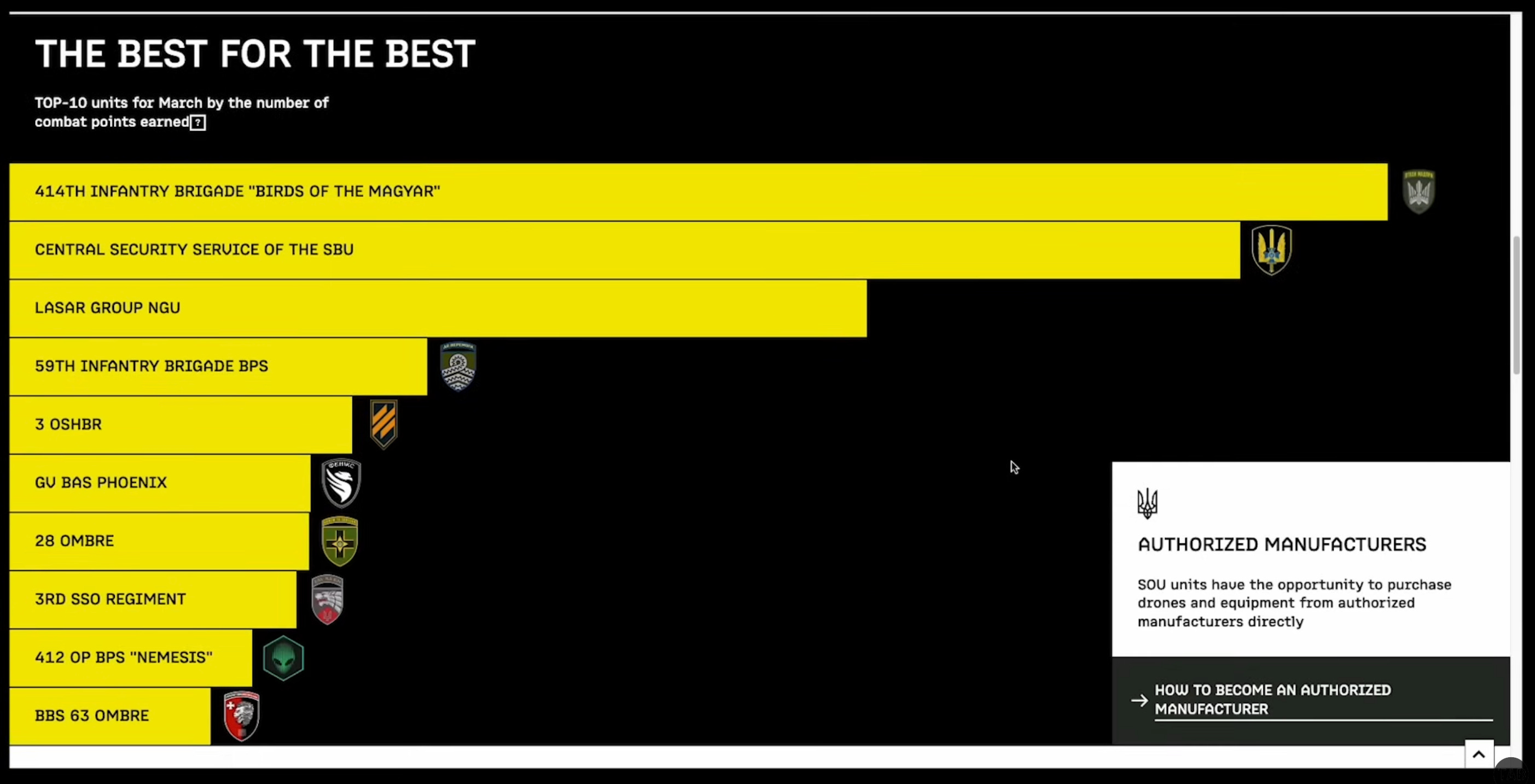
Each month, all points earned by every unit are summed up and used to form a ranking of brigades along the entire frontline. The logic is simple: the more enemy targets destroyed, the more points a unit earns—points that are then converted into new equipment.
A combat uni score card on Brave1 Market
Each point is worth 10,000 hryvnias ($239), credited as virtual funds to the unit’s account. A soldier logs in and chooses from the products available in exchange for these so-called e-points”.
Like any e-commerce platform, Brave1 Market has its glitches. Partners have whispered of “inter-unit theft,” where delivery robots fail to reach their intended destination. Ministry technicians are constantly patching the system to prevent such abuses. However, given the sheer volume of successful transactions, these errors remain marginal. —
In Wald’s Opinion
A Model for Europe: Brave1 Market is essential to the fluidity of Ukrainian operations. It should provide serious food for thought for European militaries.
Proven Tech, New Context: The underlying technology is not revolutionary—it is a derivative of Amazon or Alibaba.
Bureaucratic Agility: What is remarkable is the Ukrainian military’s ability to deploy this platform while stripping away bureaucratic interference.
The Startup Ethos: The “test, learn, adjust” methodology of the tech world has been successfully weaponized.
The Blueprint: This is a transparent demonstration of the “blueprints of modern warfare.” Whether the EU’s defense apparatus will be inspired to follow suit remains doubtful—at least not without a major geopolitical shock.